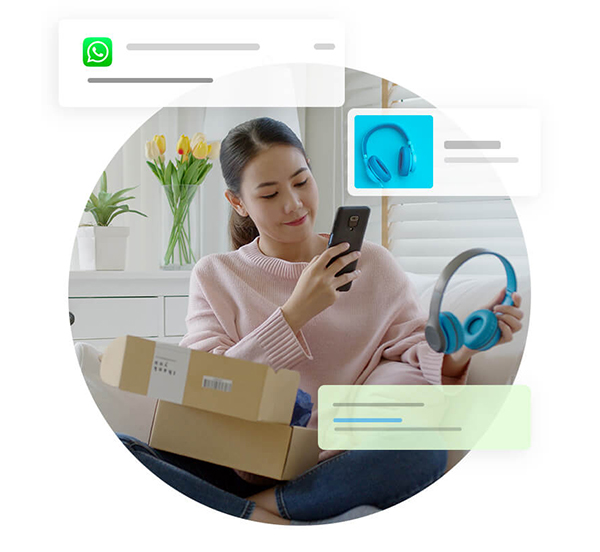
In today’s digital-first world, businesses are constantly seeking innovative ways to engage with customers. With over 2.5 billion active users, WhatsApp has become a powerful tool for customer interaction. Its high open rate of 98% makes it an ideal platform for businesses to connect with their audience. A WhatsApp chatbot is the smartest way to leverage this potential, automating responses, qualifying leads, and delivering real-time experiences.
What is a WhatsApp Chatbot?

An AI-powered WhatsApp chatbot is an automated assistant that interacts with customers via WhatsApp using artificial intelligence and natural language processing. It handles routine tasks like answering common questions, guiding users through options, or offering personalized product recommendations. By integrating with your WhatsApp business account through the WhatsApp Business API, you can streamline customer communication and deliver a peak customer experience.
Types of WhatsApp Chatbots
When choosing a WhatsApp chatbot, it’s essential to analyze your business needs. Here are three major categories:
-
Rule-Based Chatbots: These bots follow pre-programmed rules and fixed conversation flows. They respond to specific keywords or choices, making them ideal for simple FAQs and basic customer support.
-
AI-Powered Chatbots: Using natural language processing, these bots understand context and intent, making them ideal for more human conversations. AI-powered bots can answer complex queries and learn from interactions to constantly improve.
-
Hybrid Chatbots: Hybrid chatbots combine rule-based logic with AI capabilities and handle routine tasks automatically. Plus, they can escalate to human agents when needed for more complicated issues.
Benefits of Using a WhatsApp Chatbot for Businesses

Having WhatsApp chatbot tools can uplift your routine business interactions with potential customers. From enhanced response time to lead generation and sales, these bots offer many striking advantages to double the efficiency of your business.
1. 24/7 Availability
The greatest benefit of having a WhatsApp chatbot is that it never sleeps! Customers can ask any queries to the WhatsApp chatbot without considering day or night, or even weekends. For instance, a customer is out of town and needs urgent details of his order at 1 AM. Then, he can simply pick up his phone and chat with the WhatsApp Chatbot to get the information he needs without waiting.
2. Time-Saving and Efficiency
Chatbots can handle several conversations at the same time while giving rapid feedback to customers. It cuts down a significant portion of waiting time and enables your agents to spend more time on complex issues. For example, an AI-powered WhatsApp chatbot of a retail company can answer shipping or stock-related questions. It enables human agents to address other complex issues. So, it enhances customer satisfaction and employee effectiveness.
3. Cost-Effective Solution
It can be costly to hire and train customer care professionals for small companies. Henceforth, if repetitive questions like FAQs, appointment scheduling, and order tracking are answered through a WhatsApp chatbot, then it can be highly cost-effective for the company. Besides that, the popularity of WhatsApp also allows businesses to communicate with customers all over the world at an extremely low communication cost.
4. Greater Customer Interaction
Personalization is an unbeatable feature that provides the ultimate customer experience. A WhatsApp bot sends customized messages, like sending reminders based on users’ cart items, for personalized interaction. For instance, a fashion store’s chatbot can suggest new products depending on the customer’s history of purchases.
5. Lead Generation and Conversion
Beyond customer service, chatbots provide stellar customer service by receiving and sending WhatsApp messages to qualify leads. Think of a real estate bot gathering budget and geography data from a lead and then scheduling a sales call. Or a bot on an e-commerce website guiding customers through the product catalog and facilitating purchase decisions, leading to a higher conversion rate.
How to Create a WhatsApp Bot?
Automate your customer communication effortlessly with ControlHippo. Our platform lets you create a powerful WhatsApp AI chatbot quickly to improve customer engagement and enhance your customer experience.
Steps to Build and Deploy Your Chatbot on WhatsApp
-
Set Up Your WhatsApp Business Profile: Start by setting up your WhatsApp Business account. This profile is vital for enhancing your chatbot’s performance.
-
Get WhatsApp Business API Access through ControlHippo: To unlock powerful automation features like bulk message templates and personalized WhatsApp flows, you need access to the WhatsApp Business API.
-
Design Your Chatbot Flow with ControlHippo: A chatbot flow is the structured path that guides conversations between your bot and customers. It defines how the bot responds to different inputs, handles customer queries, and when it should escalate to a human agent.
-
Integrate with Your CRM or Tools: You can integrate your WhatsApp chatbot with CRM tools by connecting it through APIs or using third-party platforms like ControlHippo.
-
Test and Launch: Before launching your WhatsApp chatbot, it’s essential to thoroughly test your chatbot flow using your own testing methods or third-party tools.
-
Monitor and Optimize: After launching your chatbot, use ControlHippo’s analytics dashboard to monitor key performance indicators such as message engagement, resolution rates, and fallback instances to human agents.
WhatsApp Chatbot Use Cases by Industry
WhatsApp chatbots are reshaping the traditional way of engaging with customers, managing operations, and providing support. Here’s how different sectors are leveraging this technology:
1. E-commerce
The e-commerce sector is one of the biggest adopters of WhatsApp chatbots. According to Statista, global retail e-commerce sales will witness around 31% growth over the coming years, with expectations to come close to 8 trillion dollars by 2028. Therefore, fast and personalized communication is crucial to handle this volume effectively.
Use Cases:
– Handling product inquiries
– Tracking shipments
– Managing returns and refunds
– Guiding customers through the product catalog
Example:
A customer asks, “Where is my order?” The bot instantly retrieves the shipment status and sends a real-time update directly in the chat, reducing support calls.
2. Healthcare
In healthcare, timely communication is critical. 92% of patients expect their healthcare providers to send them personalized reminders and messages. This rising demand of the industry can be fulfilled with human-like support of a WhatsApp chatbot.
Use Cases:
– Appointment booking and reminders
– Prescription refill requests
– Patient education and FAQs
– Initial symptom screening
Example:
Patients use the bot to book appointments, receive medication reminders, or ask about clinic hours to ease the workload of staff and improve patient satisfaction.
3. Education
With each passing day, more educational institutions are adopting WhatsApp chatbots to support students and staff. Apparently, this cost-effective tool gives them peace of mind by addressing thousands of queries on a daily basis.
Use Cases:
– Answering questions about course availability and admissions
– Sharing exam schedules and project deadlines
– Guiding online registrations
– Fee payment reminders
Example:
A student asks about the application deadline. The bot quickly provides the relevant date and links to the online form, simplifying the admission process.
Top WhatsApp Chatbot Tools
Don’t get confused by the overwhelming options of WhatsApp chatbots in the market. We have identified the 5 best WhatsApp chatbot tools for you. Take a look at them:
| Tool | Key Features | Pricing |
|---|---|---|
| ControlHippo | CRM integrations, WhatsApp Business API, drag-and-drop builder, automation, analytics | Free plan; starts from $20/user/month |
| Tidio | Conversational AI, no-code builder, multi-channel support | Starts at $29/month |
| Respond.io | AI-powered NLP, unified inbox, workflow automation | Starts at $79/month |
| Gupshup | NLP, interactive messages, developer tools | Custom pricing |
| Landbot | Visual no-code builder, CRM & Zapier integrations | Starts at $39/month |
ControlHippo
ControlHippo is a smart and scalable communication chatbot designed to revolutionize how businesses engage with their customers. Powered by AI, ControlHippo enhances customer conversations with intelligent routing, real-time personalization, and automated workflows. It’s designed to amplify engagement and help you scale effortlessly as your business grows.
Features:
– AI copilot
– AI assistant
– Native CRM integrations (HubSpot, Zoho, Salesforce)
– Drag-and-drop chatbot builder
– Automated workflows
– Broadcast messages
Pros:
– Boosts customer satisfaction and loyalty.
– Frees up your team’s valuable time.
– Helps the sales team focus on high-value leads.
– Scales customer communication effortlessly as your business grows.
– Keeps operational costs down with smart automation features.
– Enhances team collaboration and simplifies message management.
– Provides real-time insights to support data-driven decision-making.
Cons:
– Requires WhatsApp Business API approval before getting started.
– Some advanced features may involve a slight learning curve for new users.
Conclusion
WhatsApp chatbots are transforming the way businesses interact with customers. With their ability to automate responses, qualify leads, and deliver real-time experiences, they offer numerous benefits for businesses of all sizes. Whether you’re a small business looking to enhance customer engagement or an enterprise seeking to streamline operations, a WhatsApp chatbot can be a game-changer.
By understanding the different types of chatbots, their benefits, and the steps to create one, you can harness the power of WhatsApp to elevate your customer experience and drive business growth. With the right tools and strategies, your business can stay ahead in the competitive digital landscape.
About the Author